The Emergency Response Guidebook (Part 4): Special hazards
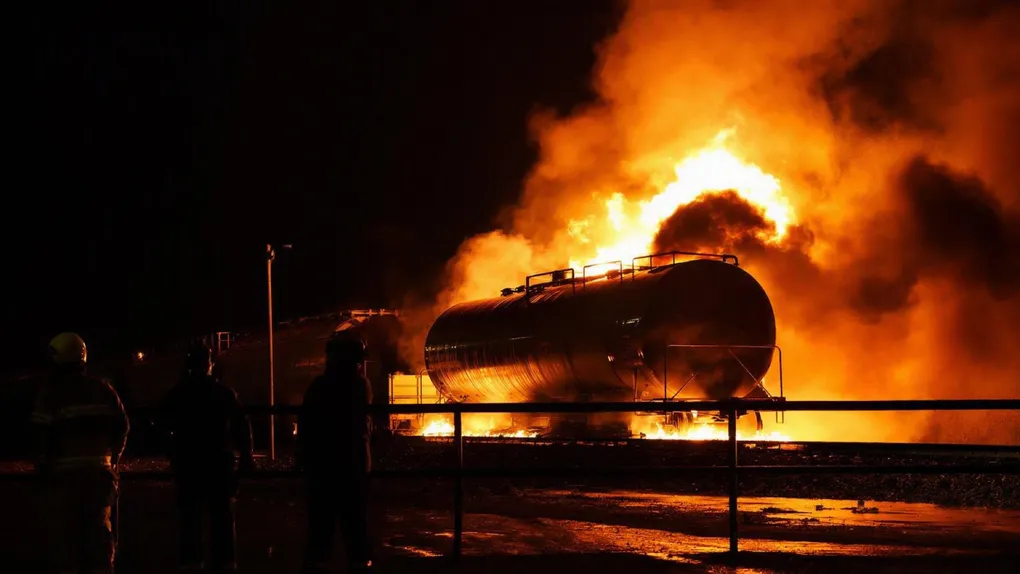
There is a video the Emergency Response Guidebook points you to, made by Transport Canada, of a propane tank car failing under a fire. The tank does not explode so much as disappear. One moment it is a cylinder in a fire, the next it is a fireball and a scatter of steel fragments, and the guidebook’s own numbers tell you how fast it happens: at four times the radius of the fireball, the heat alone burns exposed skin in two seconds.
I have watched that clip more than once, and it is why I wanted this series to end on the guidebook’s special-hazards sections. These are the scenarios that do not behave like a normal fire or a normal chemical spill: a lithium battery fire that reignites for hours, tank explosions with no readable timer, and the book’s stand-off tables for explosives. This is Part 4 of my series on the US DOT’s Emergency Response Guidebook 2024, the guide every fire truck carries. Parts 1 through 3 covered identification, protective actions, and distance tables. This part covers the special cases, plus the two supporting skills the book teaches that no household discusses honestly: what protective clothing can and cannot do, and what decontamination actually means.
Disclaimer: The information provided in this article is for general informational and educational purposes only. It is not intended as, and should not be considered, professional or emergency-response advice. The hazards described here require specialized training and equipment to respond to. Always call 911 and follow the instructions of local authorities.
The Readiness Audit
If your neighbor’s EV caught fire in the attached garage, would your first move help or hurt?
- Green: You know an EV fire needs massive water for cooling, you know the battery can reignite for hours, and you would evacuate and call 911 saying the words “electric vehicle fire.”
- Yellow: You would grab a household extinguisher, not knowing it cannot stop thermal runaway and may just trap the heat.
- Red: You would open the garage door wider to let the smoke out, or approach to check on the car.
If you are Yellow or Red, execute Phase 1 immediately.
Phase 1: Electric Vehicle and Lithium Battery Fires
Goal: Understand why these fires are different, and what the guidebook says actually works.
The core mechanism is thermal runaway: the book describes it as a chain reaction that leads to a violent release of stored energy and flammable gas, which can spread to other batteries or combustible materials nearby and become a large-scale event. What makes it different from ordinary fire is what works against it, and the guidebook is precise:
- Water spray cools batteries and helps suppress and slow the release of toxic gases, but it does not stop the chemical reaction. Cooling is the whole game, which is why EV fires take such enormous volumes of water.
- Other agents can make things worse. CO2 and dry chemical can trap heat instead of removing it, which can result in false, lower temperature readings. The fire looks out. It is not.
Caution: Never cut high or medium voltage cables. During an EV fire, responders consult the manufacturer’s emergency response guide for identifying high voltage and medium voltage cabling. Most EVs have emergency cut loops, low voltage wire loops that can be cut to disconnect the high voltage system, and disconnecting the 12-volt battery isolates power to the high voltage battery. That is responder work, on their schedule, with the manufacturer’s guide open.
The book also warns about a broader household risk. All lithium batteries can pose a fire risk, but damaged, defective, or recalled (DDR) batteries pose a higher risk because they are more likely to enter thermal runaway. The signs the book lists: leaking electrolytes, swollen or discolored battery casing, odor or corrosion, burn marks, known conditions of use or misuse, and being recalled.
The Takeaway: Water cools, nothing stops thermal runaway, and reignition is expected. Distance and professional response are the plan, and your reporting should include the words “electric vehicle” or “lithium battery.”
Phase 2: BLEVE and Heat Induced Tear
Goal: Understand the two ways a tank in a fire can fail, and why the timing is unknowable.
A BLEVE (Boiling Liquid Expanding Vapor Explosion) occurs when a fire-impinged or damaged tank fails to contain its internal pressure and explodes with a sudden product release. The book notes it is more likely with damaged pressure tank cars, even in the absence of an active fire. The LPG family includes propane (UN1978), butane (UN1011), propylene (UN1077), butylene (UN1012), isobutane (UN1969), and isobutylene (UN1055).
The book lists four hazards, and the order matters:
- Fire: if the released substance ignites, there is an immediate fireball.
- Thermal radiation: at about 4 times the fireball radius, the radiated heat is enough to burn exposed skin in 2 seconds. Protective clothing limits the dose.
- Blast: at that same distance, the blast can break window glass and cause minor building damage.
- Projectiles: tank failure can throw metal fragments over large distances, and the book notes these fragments can and have been deadly.
The danger decreases as you move away from the BLEVE center, and the furthest-reaching hazard is projectiles. That is the number that sets the perimeter, not the size of the fireball.
Heat Induced Tear (HIT) is the non-pressure tank version. Heat softens the metal, pressure rises, and the tank tears at the vapor space in its upper side, venting burning liquid and vapor at high speed. HITs rarely throw fragments the way BLEVEs do, but the book’s timing data is the part that gets my attention: heat induced tearing has occurred within 20 minutes of a derailment and as long as 10-plus hours after the initial fire.
Caution: There is no safe lingering near a burning tank. The book’s own BLEVE precautions table, which gives critical times and distances for various tank sizes, carries the warning “use with caution,” because tanks may fail earlier if damaged or corroded, and minutes to hours later depending on conditions. A timer you cannot read is not a timer.
The Takeaway: A burning tank is a bomb on a timer you cannot read. The projectile hazard sets the distance, not the visible fire.
Phase 3: Criminal Use and Stand-Off Distances
Goal: Know the guidebook’s guidance for intentional attacks, because the book treats them as a distinct category.
The guidebook includes a section on criminal or terrorist use of chemical, biological, and radiological agents, and its first instruction is the same as every hazmat call: contact 911 immediately. In the US, suspected CBRN incidents also go to the National Response Center at 1-800-424-8802.
The book’s initial-action list contains two instructions that surprised me, in a good way:
- Avoid using cell phones, radios, and similar devices within 100 meters (300 feet) of a suspect device. Radio energy can trigger certain initiators.
- Be cautious about secondary devices, improvised explosive devices placed to target the people responding to the first one.
The book also teaches how to tell the three agent types apart by their timelines, and it is knowledge worth having:
- Chemical incidents show rapid onset of symptoms, minutes to hours, with observable signatures: colored residue, dead foliage, pungent odor, dead insects and animals.
- Biological incidents show onset in hours to days, usually with no signature, because the agents are odorless and colorless. The affected area may be larger because infected people move around.
- Radiological incidents show onset in days to weeks or longer, also without signatures.
The section ends with a safe stand-off distance chart for suspected IEDs, with distances scaling from tens of meters for small pipe bombs to well beyond a hundred meters for vehicle bombs, plus guidance to put structures between you and the device where possible.
The Takeaway: For IEDs the distance decision was made for you. Be on the far side of the perimeter, keep your phone quiet within 100 meters of anything suspicious, and know that the second bomb is a real thing.
Phase 4: Protective Clothing, The Honest Version
Goal: Dispel the movie version of chemical protection, because this is where preparedness marketing lies to people.
The guidebook’s assessment of clothing is refreshingly blunt. Street clothes and typical work clothes offer almost no protection against most hazardous materials. Structural firefighters’ protective clothing provides thermal protection but only limited chemical protection. The full defense against serious vapor hazards is positive-pressure self-contained breathing apparatus (SCBA), the fully encapsulating suit you see in news photos.
One guide entry the book uses repeatedly has stuck with me. For certain toxic gases it warns that the initial odor may deaden your sense of smell, meaning the gas can take away the very sense you would use to detect it. No clothing you own answers that problem.
The implication for preparedness is not to buy a hazmat suit. It is to understand that in a serious vapor release, no household item makes you safe outdoors. Sealed buildings (Part 2) and distance (Part 3) are the only civilian defenses, which is exactly why the guidebook’s protective action system is built around them.
The Takeaway: There is no civilian clothing answer to a toxic cloud. Plan around sealing and distance, not around gear.
Phase 5: First Aid and Decontamination
Goal: Know the book’s actual medical guidance, because some of it is counterintuitive.
The guidebook’s General First Aid section opens with a warning that reframes everything: do not perform mouth-to-mouth resuscitation on a hazmat casualty, because the victim may have ingested or inhaled the substance and you would be exposing yourself. If breathing is difficult, move the victim to fresh air if it can be done safely and administer oxygen if equipped. If there is no pulse and no medical device available, provide continuous compressions and check every two minutes. The book closes the section by stating plainly that basic and advanced life support are work for trained professionals.
The rest of the section is a sequence worth knowing:
- Call 911 or emergency medical services, and make sure medical personnel know what material was involved so they can protect themselves.
- Remove and isolate contaminated clothing and shoes.
- For minor skin contact, avoid spreading material to unaffected skin.
- For contact with the substance, flush skin or eyes with running water for at least 20 minutes.
- Effects of exposure may be delayed, so keep the victim calm, warm, and under observation even if they feel fine.
The decontamination section adds the categories: technical decontamination (the formal responder process), mass decontamination (fast reduction for large numbers of people), and emergency decontamination (immediate reduction in life-threatening situations, performed upwind and uphill from victims).
Caution: The rule the book prints in capital letters: chemical neutralization releases heat. DO NOT PERFORM it on a victim. Remove clothing, flush with copious water, and let professionals handle anything beyond that. Improvised neutralizers burn the person you are trying to help.
The Takeaway: Remove, flush for 20 minutes, and get help. Never mouth-to-mouth, never neutralize on skin, and never assume a casualty who feels fine is fine.
The Essential Kit Checklist
- The EV awareness: If an EV or lithium battery is burning, evacuate, call 911, and say “electric vehicle fire” or “lithium battery fire.” Mention reignition risk so the department brings the water it needs.
- The DDR battery habit: Stop using and properly recycle any battery that is swollen, discolored, leaking, odorous, or burned. Check recall notices for the devices you own.
- The tank-fire rule: A fire involving a rail tank car means 1,600 meters (one mile) isolation in all directions in many guides, and 800 meters (half a mile) for many highway tanks. Whatever the number, the professionals set the line and you stay far beyond it.
- The decon kit: Nitrile gloves, trash bags for contaminated clothing, and a way to flush with clean water for a long time, stored in the garage, not the basement.
- The stand-off habit: At any unattended package or vehicle scare, move beyond the established perimeter immediately and do not drift back. Keep phones quiet within 100 meters of a suspect device.
Scenario Planner (Contingencies)
“The EV fire went out, so it is over.” The trap: treating thermal runaway like ordinary combustion. The fix: the guidebook’s guidance exists because EV batteries can reignite for hours after the visible fire stops, and cooling must continue. Tell responders what burned, leave the scene, and do not return until officials clear it. The same caution applies to that swollen laptop battery in your drawer: it is not a storage problem, it is a disposal problem.
“I can help the contaminated person with baking soda.” The trap: improvised chemistry on a casualty. The fix: the book’s own capital-letter warning that chemical neutralization releases heat and must not be performed on a victim. Remove clothing, flush with water for at least 20 minutes, call for help, and keep yourself out of the contamination zone while you do it.
“The burning tank is 800 meters away, that is far enough to watch.” The trap: reading safety from distance alone. The fix: the book teaches that projectiles travel farther than fire and blast, that BLEVE timing is unknowable, and that heat induced tears have occurred 10-plus hours into a fire. If a tank is burning and professionals have set a perimeter, the far side of it is where you belong, and not at its edge.
Next Steps
This series ends here, but the practice starts here. Four things to do this week:
- Go to the source. The whole guidebook is free through the link below, and the placard tables, green tables, and orange guides are worth skimming once so they are familiar before you need them.
- Audit your batteries this weekend. Every swollen, leaking, discolored, or recalled battery in the house goes to a battery recycling drop-off, not the trash and not the drawer.
- Run the series back through the readiness audits. Re-read each part’s list and be honest about which color your household is. Then close the gap it names.
- Put the hazmat lessons in family terms. The distances and decision tables only help if the whole household knows the first move, so fold them into the family communication plan.
Adapted from US DOT/PHMSA, Emergency Response Guidebook 2024 (public domain). Read the original: Emergency Response Guidebook 2024.