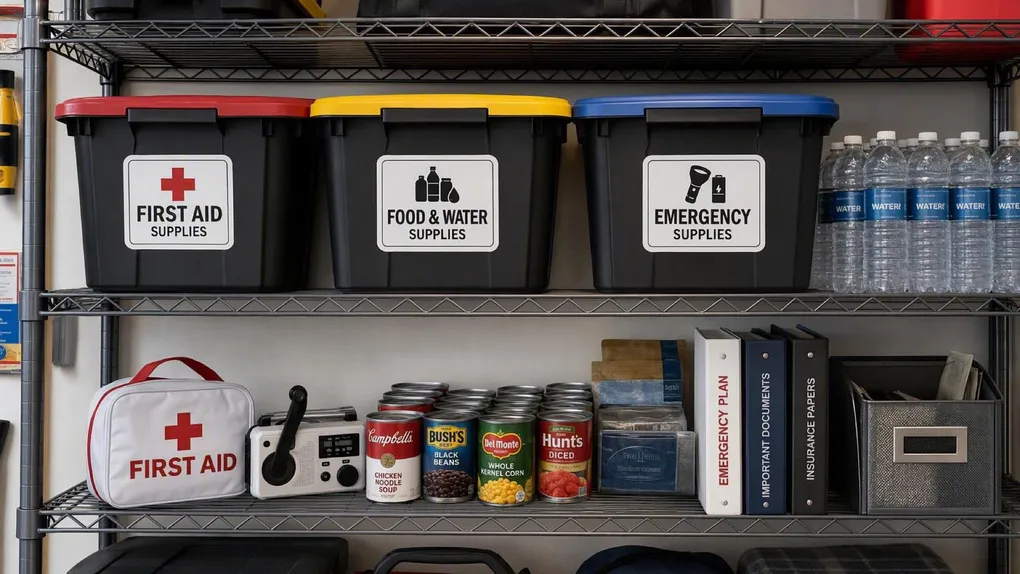
Build Your Emergency Supply Kit and Document Vault
The store is open until the disaster starts. After that, shelves empty in hours and whatever is in your house is what your family has. FEMA’s guide devotes real detail to this, because the supply kit is where preparedness stops being an idea: one gallon of water per person per day, kits at home and office and in the vehicle, and a document vault that makes recovery possible on the worst day of your life.
Disclaimer: The information provided in this article is for general informational and educational purposes only. It is not intended as, and should not be considered, legal, medical, or financial advice. Always follow the instructions of local authorities and emergency management officials.
The Readiness Audit
Where would your family get water, food, and cash tonight if the taps and registers stopped working?
- Green: Kits exist at home, work, and in the car, checked in the last six months, and documents are stored in two protected locations.
- Yellow: There is a partial kit somewhere, and the documents are in a drawer.
- Red: You would be in a store line with everyone else.
If you are Yellow or Red, execute Phase 1 immediately.
Phase 1: The Basic Emergency Supply Kit
Goal: Stock the non-negotiables.
The guide’s basic kit: water at one gallon of drinking water per person per day, kept for 3, 7, or even 14 days depending on where you live. Non-perishable food in quantities your family needs to survive a major disaster. Cash, enough for food, fuel, and a few hotel nights, because power outages close banking institutions and take down credit cards and ATMs. A battery-powered or hand-crank radio plus a NOAA All Hazards Weather Radio with tone alert, with spare batteries for both. A flashlight and extra batteries, a first aid kit, a whistle, N95 respirators (several, each fit-tested for a tight seal), a wrench or pliers for turning off utilities, a can opener and food prep tools, and local maps.
The Takeaway: Every item on the basic list answers a specific failure: water for the taps, cash for the card readers, the radio for the internet, the whistle for the rubble. If you do not know why an item is on the list, imagine the failure it answers.
Phase 2: The Add-Ons and the Three-Kit System
Goal: Customize and distribute the kit.
The guide’s additions: prescription medications and glasses, infant formula and diapers, pet food and extra water, important family documents, emergency reference material, a sleeping bag or warm blanket per person, complete changes of clothing, a water purification system, a fire extinguisher, hygiene products, mess kits and paper goods, paper and pencil, and books or games for children and adults. The list is a guide, not a rule: adjust for ages, diets, health, mobility, and local climate.
Then the distribution rule. Store supplies in different places, because you do not know where you will be when the event hits. Home: the full kit in a designated spot everyone knows, ready to grab. Office: enough to shelter at work for at least 24 hours, including food, water, comfortable walking shoes, and medicines. Vehicle: a kit for being stranded on the road. Every kit gets essential medications.
Maintenance is part of the system. Check needs every six months. Keep canned food dry and cool, throw out anything expired, swollen, dented, or corroded, rotate new items to the back and older ones to the front, keep items in airtight plastic bags, and pack the whole kit into one or two easy-to-carry containers like a trashcan, camping backpack, or duffel. Store commercially bottled water with the kit, not tap water.
The Takeaway: One kit is a single point of failure. The home-office-vehicle trio means the kit is where you are, and the six-month rotation means it still works when you need it.
Phase 3: The Document Vault
Goal: Protect the paperwork recovery runs on.
Gather the valuables and information that help you recover quickly: household identification like property deeds or leasing agreements, financial and legal documents like bank statements and paystubs, medical information and proof of insurance including records and doctor contacts, and emergency or hotline contact numbers. Make a list of household belongings and valuables, because you may need that inventory for insurance records. FEMA’s Emergency Financial First Aid Kit (EFFAK) is the guide’s recommended template.
Protection is two-layered. Keep paper copies at home in a fire- and waterproof box or safe, in a bank safe deposit box, or with a person you trust. Keep electronic copies password-protected and encrypted on a removable flash or external hard drive.
The Takeaway: The kit keeps you alive, the vault keeps you whole. Deeds, statements, and medical records are what insurance and federal aid run on, and replacing them from scratch after they burn or flood takes months.
The Essential Kit Checklist
- The Water: One gallon per person per day, stocked for your household’s target duration.
- The Food: Non-perishables sized for a major disaster, rotated on schedule.
- The Cash: Bills on hand for food, fuel, and lodging when networks are down.
- The Radios: Battery or crank radio plus a NOAA weather radio with tone alert, spare batteries for both.
- The Three Kits: Home, office (24 hours), and vehicle versions assembled and stocked.
- The Vault: Documents in a fire/waterproof box or safe deposit plus encrypted digital copies elsewhere.
- The Six-Month Check: A recurring reminder to review the kit and rotate supplies.
Scenario Planner (Contingencies)
“We will just buy water when the forecast looks bad.” The trap: everyone else has the same idea, and the store has been empty since the first local case of bottled water sold. The fix: the guide’s amounts (one gallon per person per day) exist to be bought in calm weather, and the rotation system keeps old stock fresh.
“All our records are online anyway.” The trap: cloud services need power and networks, and some records, like deeds, are faster to use as paper. The fix: the two-layer vault, paper in protected physical storage and encrypted digital copies elsewhere, survives either system failing.
Next Steps
- Re-run the Readiness Audit. Scroll back to the top, answer the three questions honestly, and close whichever gap they reveal before you close this tab.
- Print the checklist. The kit list above only works if it exists when the power is out, so paper beats apps here.
- Fold it into the family plan. A prepared household beats prepared person, so put these steps in front of everyone who shares your roof.
Next: Read Alerts, Insurance, and Protecting Your Property to put financial armor around everything the kit protects.
Adapted from Federal Emergency Management Agency - Are You Ready? An In-Depth Guide to Citizen Preparedness (public domain). Read the original: Are You Ready? An In-Depth Guide to Citizen Preparedness.