Prepping for anything (Part 5): Alerts and warnings
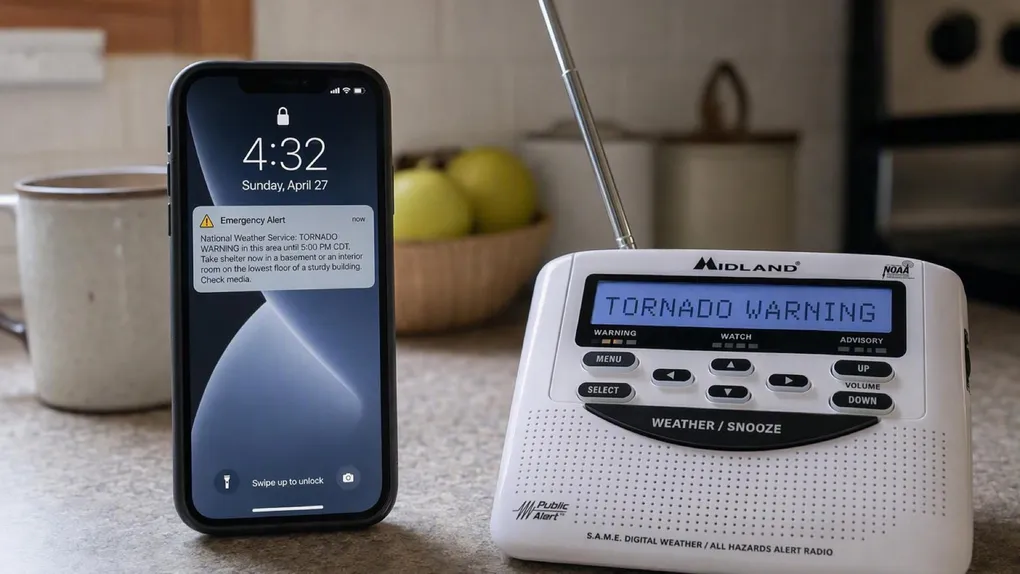
The tornado siren failed the night the EF3 came through, and the family in the split-level survived anyway, because eleven minutes earlier their phones had buzzed with a Wireless Emergency Alert while a battery NOAA radio repeated the warning every sixty seconds. Down the street, a household with the same phones, set to silent, learned about the tornado from the sound of it. Two families, one storm, one alert system. The difference was who had enabled what, and whether anything in the house worked when the power did not.
A warning only helps if you receive it, and if you know what it means. The difference between a watch and a warning can be the difference between life and death, yet many people cannot tell them apart.
Caution: A silent phone is a missed warning. Alerts do not reach you by magic. You must sign up for them, enable them, and make sure your whole household gets them. The best warning system in the world is useless if your phone is on silent and your radio is in a drawer. This is Part 5 of the “Prepping for anything” series.
Disclaimer: The information provided in this article is for general informational and educational purposes only. It is not intended as, and should not be considered, professional or emergency-response advice. Always defer to the alert and follow the instructions of local officials.
The Readiness Audit
Would you actually receive a warning if one were issued right now?
- Green: You are signed up for local alerts, Wireless Emergency Alerts are enabled, and you own a NOAA weather radio with battery backup.
- Yellow: You rely on your phone’s default settings and have never signed up for anything.
- Red: You would not know a warning had been issued until you saw it on the news.
If you are Yellow or Red, execute Phase 1 immediately.
Phase 1: The Three Alert Levels
Goal: Know what each alert word means.
- Advisory, be aware: a hazard is expected in your area, but its impact is not expected to be life-threatening.
- Watch, be prepared: a hazard may possibly occur in your area. Conditions are favorable.
- Warning, take action: a hazard is expected, imminent, or already occurring, and its impact may be serious.
The Takeaway: Advisory = aware. Watch = prepared. Warning = act now. Three words, three levels of urgency.
Phase 2: The “This Is a Test” Message
Goal: Use test messages as a free drill.
- The test: officials sometimes send test or practice messages. Do not ignore them.
- The opportunity: use a test as a reminder to check your emergency plan and supplies.
- The review: revisit the full framework for more steps to take.
The Takeaway: A test message is a free reminder to audit your readiness.
Phase 3: The Receiving Systems
Goal: Make sure alerts actually reach you.
- The signups: learn which alert systems are available in the areas where you spend time, and subscribe to them. Officials can then send you text or email messages about local emergencies.
- The wireless alerts: double-check that your mobile devices can receive Wireless Emergency Alerts (WEAs), and enable them, even bypassing silent mode.
- The apps: use mobile apps with local alert functions, such as the FEMA app, which offers notifications on local threats.
- The radio: keep a NOAA All-Hazards Weather Radio with tone alert and battery backup, it works when cell towers fail.
- The household rule: make a list of all alert systems available to you, and make sure everyone in your household gets them.
The Takeaway: Redundancy is the point. Phone, radio, and app, three ways to hear the same warning.
Phase 4: The Hazard-Specific Alerts
Goal: Know the alerts for the hazards you face.
Different hazards have different alert types. A tornado has a watch and a warning. A blizzard has only a warning (no watch). A flash flood warning means minutes, not hours. Learn the specific alerts for your top hazards, the ones you identified in Part 1.
The Takeaway: The alert vocabulary is hazard-specific. Know the words for the threats you actually face.
The Essential Kit Checklist
- The signups: subscribe to every local alert system.
- The WEA check: enable Wireless Emergency Alerts on all phones.
- The radio: buy a NOAA weather radio with battery backup.
- The household list: make sure everyone in the family is subscribed.
Scenario Planner (Contingencies)
“My phone is always on silent, but I’ll see the alert eventually.” The trap: a missed warning. The fix: Wireless Emergency Alerts can bypass silent mode. Enable them, and keep a NOAA radio as a backup that does not depend on your phone at all.
“I got a ‘test’ alert and ignored it.” The trap: treating the test as noise. The fix: use every test message as a free drill, check your plan, your supplies, and your family’s readiness. The test is the rehearsal for the real thing.
Next Steps
- Enable Wireless Emergency Alerts on every phone in the house today. It is two settings taps, and it is the alert that bypasses silent mode.
- Buy the NOAA weather radio with battery backup and program your county’s frequency, because it works on nights the towers and the grid do not.
- Read Part 6: Recovering from disaster next, for what happens after the warning: safe re-entry, the insurance claim, and the scammers who arrive with the storm.
Adapted from FEMA Ready.gov “Are You Ready?” (public domain).