The Emergency Response Guidebook (Part 3): Toxic gas distances
There is a number buried in the Emergency Response Guidebook 2024 that changed how I think about a chemical spill: 3.9 kilometers. That is the downwind evacuation zone for a single small spill of one common toxic gas, at night. In daytime the same spill reaches 1.0 kilometer. Same chemical, same wind, same amount. The only thing that changed was whether the sun was up.
I found that number in the guidebook’s green section, the part every fire truck in the country carries, and I have not looked at my county’s industrial corridor the same way since. This is Part 3 of my series distilling the US DOT’s Emergency Response Guidebook for the rest of us. Part 1 covered identifying what you are looking at. Part 2 covered the evacuate-or-shelter decision. This part covers the numbers underneath both decisions: how far is far enough, and why the answer depends on the chemical, the spill size, the hour, and even the shape of the land.
Disclaimer: The information provided in this article is for general informational and educational purposes only. It is not intended as, and should not be considered, professional or emergency-response advice. Isolation and protective action distances in an actual incident are set by trained emergency officials using the full guidebook. Never substitute this article for official instructions.
The Readiness Audit
If a tanker car started leaking a toxic gas a mile from your home tonight, would you know whether you were inside the danger zone?
- Green: You know the small-versus-large spill threshold, you know night distances are much larger, and you know the two zone shapes (a circle and a plume).
- Yellow: You know to move away, but you would not guess that a drum-sized spill can push a toxic zone over a kilometer.
- Red: You would judge safety by sight and smell, and stay home because “it is a mile away.”
If you are Yellow or Red, execute Phase 1 immediately.
Phase 1: Two Zones, Two Shapes
Goal: Understand the geometry of a toxic release, because the two zones behave differently.
The guidebook’s green tables define two zones for each material, and the definitions are precise:
- The Initial Isolation Zone is the area surrounding the incident in which people may be exposed to dangerous concentrations upwind and life-threatening concentrations downwind. This is the circle around the source. The book’s first measure, before any table lookup, is always to isolate at least 100 meters (330 feet) in all directions.
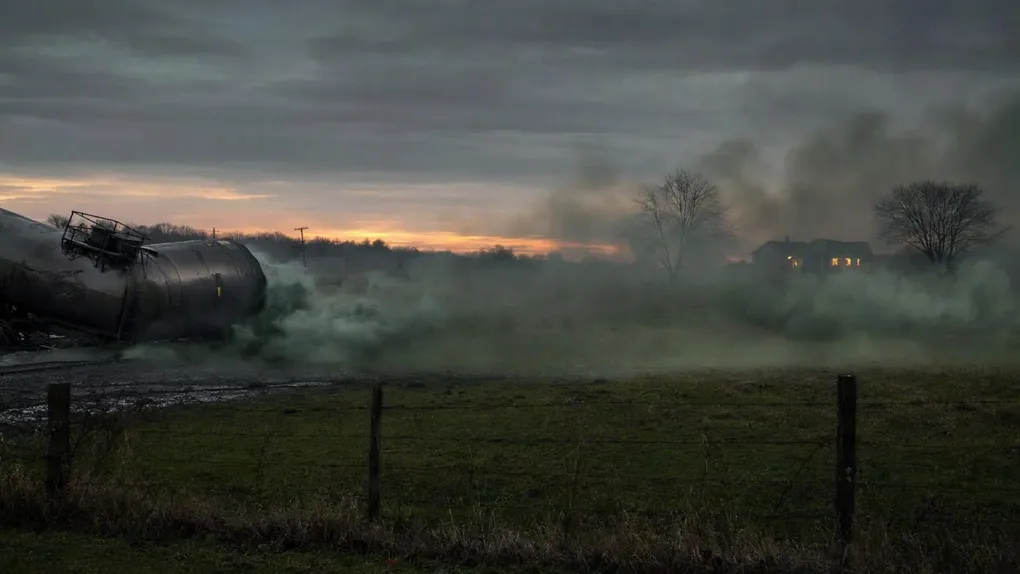
- The Protective Action Zone is the area downwind from the incident in which people may become incapacitated and unable to take protective action, or incur serious or irreversible health effects. This is the plume stretching away from the spill, in the direction the wind blows.
Table 1 predicts the size of the area a toxic gas cloud could affect, and people in that area should be evacuated, sheltered-in-place inside buildings, or both. The book defines “isolate” as a zone of no entry, applying to the public and to responders who are not equipped and trained to mitigate the incident.
The Takeaway: The circle is about the source. The plume is about the air. You can be outside the circle and still inside the plume.
Phase 2: The Two Spill Sizes
Goal: Learn the threshold that decides which distance column applies, because it is smaller than you think.
The tables split every scenario by spill size, and the dividing line is one drum:
- Small spills involve 208 liters (55 US gallons) or less.
- Large spills involve greater quantities.
The distances themselves come from serious work, and knowing that makes me trust them. The book describes an analysis using state-of-the-art emission rate and dispersion models, statistical release data from the US DOT’s own incident database, hourly meteorological records from more than 120 locations across the US, Canada, and Mexico, and current toxicological exposure guidelines. For each chemical, thousands of hypothetical releases were modeled, and the 90th percentile distance was selected. Nine releases out of ten fall inside the stated distance.
Caution: The tables assume one substance and one source. The book is explicit that adjusting distances for a specific incident involves many interdependent variables that only qualified personnel should attempt. But the book does give honest general rules for when the distances grow, and I cover those in Phase 4.
The Takeaway: One drum is a small spill. A tanker is not. The column matters more than the estimate.
Phase 3: Night Changes Everything
Goal: Understand why the same spill at night demands a distance four times larger, because this is the fact that surprises everyone.
The guidebook explains the mechanism plainly. During the night the air is generally calmer, which causes vapor to disperse less and creates a greater toxic zone. In daytime the atmosphere is more active, so the vapor disperses more, the concentration in the surrounding air drops, and the area reaching toxic levels is smaller.
The book defines the terms: daytime is after sunrise and before sunset, nighttime is between sunset and sunrise. Then it gives the worked example that stuck with me. A small spill of UN1955, a toxic compressed gas, needs an initial isolation distance of 150 meters (500 feet). Its protective action distance is 1.0 kilometer (0.6 miles) in daytime and 3.9 kilometers (2.4 miles) at night.
Read that again. A drum-sized spill. Nearly four kilometers of downwind danger zone, because the sun went down.
The book even flags the edge cases where day behaves like night: a daytime spill in a region with strong temperature inversions or snow cover, or one occurring near sunset, may require using the nighttime distances because airborne contaminants mix and disperse more slowly.
The Takeaway: The same chemical, the same spill, the same wind. Night multiplies the distance. If you hear about a toxic release after sunset, take it four times more seriously.
Phase 4: When the Distances Grow
Goal: Learn the conditions the book says push the numbers up, because real incidents rarely match the model’s assumptions.
The green tables come with honest warnings, conditions where the printed distances are too small:
- Fire involving the container: the orange guides give a separate, larger distance against fragmentation. If a fire is involved, the fire hazard distance becomes the isolation distance, with Table 1 still used to protect downwind from residual release.
- Terrorism, sabotage, or catastrophic accident: if an entire package releases instantaneously, the book says doubling the initial isolation and protective action distances is appropriate in the absence of other information.
- More than one large package leaking: large-spill distances may need to be increased.
- Channeling: if the plume is funneled through a valley or between tall buildings, distances grow because the plume mixes with less air.
- Heat: if the liquid or the outdoor temperature exceeds 30 degrees C (86 degrees F), the protective action distance may be larger.
- The 11.0+ km entries: some materials show distances listed as “11.0+ km (7.0+ miles)”, and the book says those can be even larger in certain atmospheric conditions.
The Takeaway: The printed distances are floors, not ceilings. Fire, heat, terrain, and malicious acts all stretch them.
Phase 5: Water Makes It Worse
Goal: Know why some chemicals get more dangerous when water touches them, because this is the trap improvisers fall into.
Some materials react with water to produce large amounts of toxic inhalation hazard gases. The guidebook flags these in Table 1 with the note “(when spilled in water)”, and Table 2 lists them with the gases they produce. Some materials get two entries, one for land spills and one for water spills, and the book says to choose the larger protective action distance if it is not clear where the spill is, or if the spill touches both.
The book adds a detail that matters for anyone near a waterway: when a water-reactive, toxic-gas-producing material spills into a river or stream, the source of the toxic gas may flow downstream for a great distance. The poison is not fixed to the spill site. It travels with the water.
This creates the trap: spraying water on a spill of one of these materials manufactures poison gas. The response guidance for each material accounts for this, which is one more reason response belongs to trained responders carrying the full tables.
The Takeaway: Water is not always the antidote. For some chemicals it is the accelerant, and moving water carries the problem downstream.
Phase 6: The Six Gases With Their Own Table
Goal: Know the six toxic gases that get dedicated treatment, because they are the ones most likely to move through your area.
Table 3 gives large-spill distances for six commonly encountered toxic inhalation hazard gases, broken down by container type, day versus night, and wind speed (low, moderate, high):
- UN1005, Ammonia, anhydrous. Agriculture and refrigeration. If you live near farm country, this is the one to know.
- UN1017, Chlorine. Water treatment and chemical manufacturing.
- UN1040, Ethylene oxide (and ethylene oxide with nitrogen). Medical equipment sterilization.
- UN1050, Hydrogen chloride, anhydrous and UN2186, Hydrogen chloride, refrigerated liquid. Chemical processing.
- UN1052, Hydrogen fluoride, anhydrous. Petroleum refining and industrial cleaning.
- UN1079, Sulfur dioxide. Food processing and industrial uses.
These six get their own table because they are transported in quantity and their vapor clouds travel far. Table 3 even varies the distances by wind speed, which tells you something the simpler tables cannot: a low-wind night holds the plume together and pushes it farther than a windy one.
The Takeaway: These six gases justify knowing the tables exist. Their names appear on placards you learned to read in Part 1.
The Essential Kit Checklist
- The distance anchors: Memorize two numbers. Always isolate 100 meters (330 feet) around any spill, and treat night distances as several times the day distances until told otherwise.
- The spill-size sense: 55 gallons (208 liters) is the small-spill line. Anything tanker-sized is automatically large.
- The plume habit: In any release, know which way the wind is blowing, because the danger zone is a plume, not a circle.
- The terrain check: If you live in a valley or among tall buildings, assume the plume channels and travels farther than the printed tables suggest.
- The six-gas awareness: Know that ammonia, chlorine, ethylene oxide, hydrogen chloride, hydrogen fluoride, and sulfur dioxide are the six common toxic gases with dedicated tables.
- The official-instructions rule: In an actual event, only official instructions carry the correct distances. These numbers teach scale, not procedure.
Scenario Planner (Contingencies)
“A drum-sized spill is small, so a few hundred feet is fine.” The trap: treating the small-spill column as safe rather than less-dangerous. The fix: even the small-spill protective action distance for the UN1955 example was 1.0 kilometer in daytime and 3.9 at night, and the initial isolation radius is 100 meters for every material, small spill or not. The size column changes the numbers, not the principle of distance.
“The vapor cloud went that way, so we are fine.” The trap: treating wind direction as fixed. The fix: the guidebook’s weather factors include the potential for change, and its whole system tells officials to keep gathering information until the threat is removed. Plumes shift with the wind. That is why evacuees should go far enough that a wind shift does not force a second move, the point Part 2 covered.
“It spilled in the creek, so at least it is diluted.” The trap: assuming water fixes chemical problems. The fix: for water-reactive materials, water is the problem. The book warns that the toxic gas source may flow downstream for a great distance. If a chemical spill touches a waterway near you, the danger may arrive before the smell does.
Next Steps
Do these four things this week, in order:
- Read Part 4: Special hazards covering EV fires, BLEVE explosions, and improvised explosive stand-off distances.
- Learn your two anchors tonight. Isolate 100 meters (330 feet) around any spill, and multiply night distances several times over day distances. That is the whole table, compressed to two habits.
- Find your wind answer before you need it. Stand outside your home and workplace and note which direction the wind is moving right now. The plume question only has one honest answer, and you cannot look it up while a cloud is forming.
- Prep the stay-in kit that distance decisions assume. When officials seal a zone, they are buying time for sheltering to work, so make sure your household can hold with the emergency supply kit.
Adapted from US DOT/PHMSA, Emergency Response Guidebook 2024 (public domain). Read the original: Emergency Response Guidebook 2024.